

Structuring the capital, technology, and governance behind the Gulf's climate transition.
The Middle East now stands at the center of global climate capital and technology deployment. Sovereign wealth funds across the region are projected to manage close to 8 trillion dollars by 2030, while national hydrogen and desalination megaprojects are redefining what energy and water security look like at scale. 751.Middle East exists to help governments, sovereign investors, and technology partners convert that ambition into bankable, well-governed programmes.
Why the Middle East
Capital at Unprecedented Scale
Gulf sovereign wealth funds, led by Saudi Arabia's PIF, the UAE's ADIA, Mubadala and ADQ, and Qatar's QIA, now sit among the most influential pools of capital in the world. Much of this wealth is increasingly directed toward climate and technology investment, including new dedicated vehicles focused on decarbonisation and resilience. As donors rather than recipients within the global climate finance system, these states are well positioned to extend that capital toward neighbouring countries with pressing climate needs and existing funding gaps.

Technology Moving at Speed
Saudi Arabia has just completed one of the world's largest green hydrogen facilities, producing hundreds of tons of carbon free hydrogen daily using solar, wind, and desalinated seawater. The UAE and Oman are running parallel hydrogen strategies at national scale, positioning the Gulf as a global leader in industrial decarbonisation and proving out technology models that can be transferred to water stressed and energy constrained neighbours across the wider region.
A Clear Gap We Are Built to Fill
While clean energy investment accelerates inside the Gulf, climate finance flowing to neighbouring Arab states such as Jordan, Lebanon, Iraq, Yemen, and Syria remains thin relative to the scale of need, particularly for water security, adaptation, and biodiversity. This is precisely where 751 is built to add value, structuring the bridge between Gulf capital and fundable, well governed programmes in the countries positioned to receive it.

Our Synergies
-
Regional Capital Deployment. Positioning UAE, Qatar, and Saudi sovereign wealth and donor capital to support climate resilient development in neighbouring Arab states such as Jordan, Lebanon, Iraq, Yemen, and Syria, where National Designated Authorities are already active but underfunded.
-
Water and Desalination Finance. Structuring investment and governance frameworks around desalination, which already supplies over 60 percent of Saudi Arabia's potable water and underpins the region's hydrogen strategy, with transferable models for water stressed neighbouring states.
-
Sovereign Co-Financing Structuring. Supporting Gulf sovereign wealth funds and donor institutions in designing blended finance vehicles that channel capital into climate aligned programmes across the wider Middle East and North Africa region.
-
Governance and Impact Reporting. Delivering monitoring, evaluation, and compliance systems that meet the standards Gulf donors and co-financiers require before committing capital to cross border regional programmes.
-
GCF and NDA Pipeline Access. Providing a direct route between Gulf capital and eligible National Designated Authorities in Jordan, Lebanon, Iraq, Yemen, Bahrain, Kuwait, Oman, and Syria, closing the gap between available donor funds and fundable, delivery ready proposals.

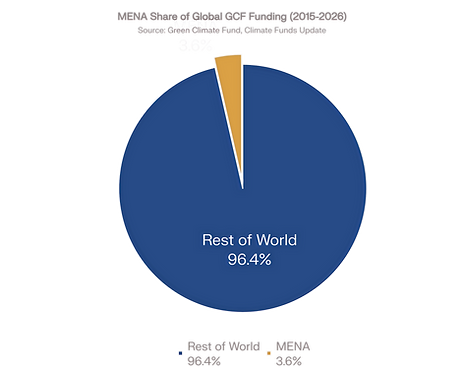
"Despite housing some of the world's most active sovereign capital and pressing climate resilience needs, the Middle East and North Africa region has received only around 730 million dollars from the Green Climate Fund over the past decade, representing approximately 3.6 percent of the fund's 20.4 billion dollar global portfolio. This figure covers the fund's entire operating history, since GCF only began approving projects in November 2015, meaning the region's funding share has remained persistently thin across the full ten years the fund has been active. This stands in sharp contrast to the scale of capital the region's own sovereign wealth funds now deploy, and underscores the significant gap between available international climate finance and the resources actually reaching neighbouring states such as Jordan, Lebanon, Iraq, and Yemen. Jordan alone accounts for the majority of this activity, having secured the single largest GCF project ever approved in the region, a 295 million dollar investment supporting a 6 billion dollar national desalination programme. The disparity between global fund allocation and Gulf capital capacity, sustained over a full decade, is precisely the gap 751.Middle East is positioned to close."
"While the Gulf states are projected to control nearly 8 trillion dollars in sovereign wealth by 2030 and are investing heavily in their own green hydrogen and desalination megaprojects, none of the six wealthy Gulf economies, the UAE, Saudi Arabia, Qatar, Kuwait, Bahrain, or Oman, appear as confirmed contributors to the Green Climate Fund across any of its three major fundraising rounds. By contrast, the United Kingdom, Germany, France, Japan, and the United States have together pledged over 21 billion dollars since the fund's inception, effectively financing climate resilience across the developing world on behalf of a region that has historically borne comparatively little of that cost. This absence stands in stark contrast to the region's own domestic capital ambitions, and represents one of the clearest opportunities for the Gulf to convert its growing climate wealth into direct, high-visibility support for its neighbours, rather than routing that capital exclusively through independent, self-directed vehicles outside the multilateral system."

How 751 Middle East can Help Reduce the Disparity

751.Middle East can serve as the practical bridge between Gulf capital and technology, and finance-ready climate programmes in neighbouring countries. Its value is not to ask Gulf states to become conventional GCF recipients, but to help them deploy capital strategically as co-financiers, investors, technology partners, and long-term regional resilience leaders.
The 751 Role
751 Earth Family Group provides the wider international platform, with capabilities in climate-finance programme design, stakeholder coordination, governance, safeguards, monitoring and evaluation, water security, nature, renewable energy, and food systems. 751.Middle East becomes the regional market-facing vehicle: engaging sovereign wealth funds, family offices, development banks, technology suppliers, utilities, universities, and government decision-makers across the Gulf. It identifies where their capital and technology can complement national priorities in countries such as Jordan, Lebanon, Iraq and Yemen. 751.Africa and 751.Atlantic add investible programme opportunities in water, blue economy, biodiversity, coastal resilience, renewable energy, and climate-smart food systems, creating a credible cross-regional pipeline for Middle Eastern partners.
The Delivery Model
Identify priority needs. Work with governments, NDAs, municipalities, utilities, and communities in eligible neighbouring countries to define nationally owned priorities, particularly water security, renewable energy, resilient food systems, coastal protection, and nature recovery. GCF Readiness support is expressly designed to strengthen country capacity, planning, governance, and investment pipelines through NDAs or focal points. Build finance-ready programmes. Develop the evidence base, theory of change, feasibility work, financial model, safeguards, gender and inclusion measures, procurement approach, risk framework, M&E system, and investment narrative required for institutional due diligence. Structure the capital stack. Match grants, concessional finance, guarantees, equity, debt, philanthropy, and technology contribution in a blended structure that reduces investor risk while preserving public benefit. GCF can support this approach through Accredited Entities, which develop and submit proposals with countries, while its Private Sector Facility is specifically intended to mobilise private-sector investment. Connect capital to delivery. Convene Gulf investors, sovereign institutions, technology providers, and prospective co-financiers around an agreed pipeline, rather than relying on disconnected project pitches. This gives partners a disciplined route to assess opportunities against shared standards of impact, governance, commercial feasibility, and national alignment. Stay through implementation. Provide independent programme governance, compliance, monitoring, verification, performance reporting, partner coordination, and capacity building so investments deliver credible results over the long term. What Gulf Partners Gain A regional pipeline: Credible, screened opportunities connected to climate needs in neighbouring countries, rather than speculative or unstructured proposals. Lower transaction risk: Projects are prepared against institutional standards before capital is committed, including financial, safeguards, delivery, and impact requirements. Visible regional leadership: Gulf capital can demonstrate measurable support for water, resilience, livelihoods, and low-carbon development across the wider region. Technology deployment: Gulf-developed capability in desalination, renewable power, green hydrogen, water efficiency, digital monitoring, and climate-smart infrastructure can be adapted for regional use. Measurable impact: A common results framework enables investors and public partners to report consistently on resilience, emissions, water access, biodiversity, jobs, and community benefit.
Flagship Opportunity
A strong first thematic platform would be a Regional Water Security and Climate Resilience Facility. It could combine Gulf finance and water technology with nationally owned programmes in Jordan, Lebanon, Iraq, and Yemen, covering desalination where appropriate, renewable-powered water systems, wastewater reuse, leakage reduction, watershed restoration, drought-resilient agriculture, and municipal capacity. Jordan provides a particularly relevant entry point because its existing GCF engagement has already combined readiness work, project-pipeline development, direct-access capacity, water programmes, and private-sector mobilisation. This means 751 can use a credible regional logic: Gulf capital supports practical resilience investment in neighbours, while the 751 Earth Family Group ensures the programmes are properly designed, governable, finance-ready, and accountable.
How 751.Middle East Helps
"751.Middle East connects Gulf capital, technology, and strategic ambition with finance-ready climate programmes across the wider region. Working as part of the 751 Earth Family Group, we help governments, investors, technology partners, and delivery institutions move from national priorities to well-governed investment programmes. We identify opportunity, structure partnerships, prepare projects for institutional due diligence, and support delivery long after financing is secured. For Gulf investors and technology leaders, this creates a clear route to support neighbouring countries through practical investments in water security, renewable energy, resilient food systems, biodiversity, and coastal protection. For partner governments, it brings together the capital, expertise, and programme discipline needed to turn climate priorities into measurable results. Our role is to make regional climate cooperation investible, accountable, and built to last."


HRH Prince Abdulla bin Sultan Al Saud with Founder of 751. Earth Family Group, Dr Karen Sumser-Luspon 2023 (Bahrain)
Founding Partners Invitation
A Limited Invitation to Shape What Comes Next
751.Middle East is convening a small, founding group of strategic partners to help shape a new regional platform focused on water security and climate resilience across the wider Middle East.
We are not opening this broadly. A limited number of individuals and institutions, selected for their vision, capital strength, and regional influence, are being invited to join this founding circle before the platform opens more widely. Founding partners will help define the pipeline, the governance model, and the terms of engagement for everyone who joins after them.
This is an invitation to lead, not simply to fund.
What Founding Partners Receive
-
Early visibility of our curated regional pipeline, before it is shared more widely
-
A direct role in shaping how Gulf capital and technology translate into resilience across neighbouring countries
-
Recognition as a founding voice in a platform built to last well beyond any single project
-
The opportunity to define the terms of engagement before wider partners are invited to participate